
A 72-hour power outage sounds like a nightmare, but it happens more often than you think. In February 2025, parts of Spain were without power for three days after a severe storm. In September 2024, large parts of Europe went down due to a high-voltage grid failure. Whether it's extreme weather, cyberattacks, or infrastructure failures — being prepared means peace of mind.
In this article, we'll show you how to build a complete 72-hour backup power setup with a budget of €1,500 to €3,500 that keeps the essential appliances in your household running.
Step 1: Identify your critical appliances
Before you buy a single battery, you need to know what you want to keep running. Make a list with three categories:
- Category 1 — Must-have: Refrigerator, phone charger, LED lighting, medical equipment
- Category 2 — Important: Router/internet, laptop, freezer, central heating pump
- Category 3 — Comfort: TV, washing machine, dishwasher, electric cooking
For 72 hours, focus on categories 1 and 2. Category 3 can wait until the power comes back.
Realistic consumption
An average refrigerator uses 1.5-2 kWh per day. A router 15W = 0.36 kWh/day. LED lighting for 3 rooms 0.2 kWh/day. Charging a phone 0.015 kWh per charge. Total for basic needs: 2-2.5 kWh per day.
Step 2: Choose the right capacity
For 72 hours (3 days), you need 6-8 kWh of storage if you're running just the basics. Here are three realistic options:
| Option | Capacity | Budget | Suitable for |
|---|---|---|---|
| Budget | 1,500 Wh | €1,500 | Phones, lighting, router (24-48 hours) |
| Standard | 3,000 Wh | €2,500-3,000 | + Refrigerator, laptop (48-72 hours) |
| Premium | 5,000+ Wh | €4,000+ | + Freezer, TV, small appliances |
Step 3: Ensure charging options
A battery without a way to charge it is dead after a few days. During a power outage, your normal 230V charger no longer works. You have two options:
Option A: Solar panels (fully independent)
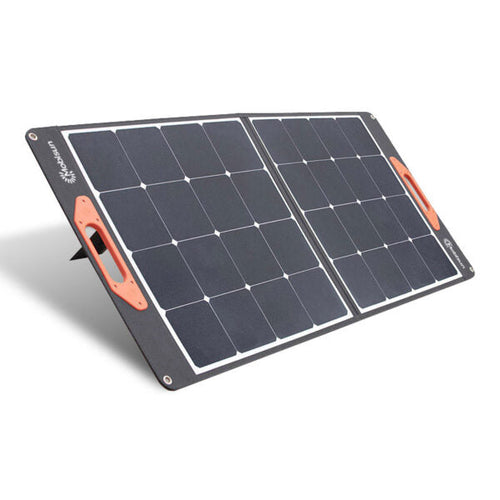
One or two foldable 100W solar panels deliver 400-600 Wh per day in summer. In winter, that's about half. For a 3000Wh battery, this means you can stay independent for 5-7 days in summer, and 2-3 days in winter.
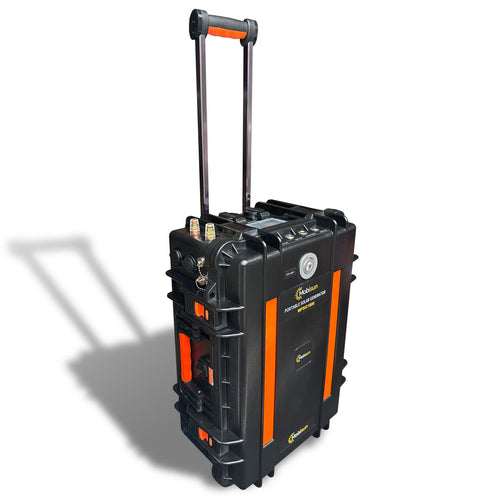
The PSG1800 Bundle with 4x 300W solar panel is the ideal solution for this: 3000Wh of storage + 1200W of solar power fully recharges your battery in 4 hours of sunshine.
Option B: Car or generator
Most power stations have a 12V car input. With the engine running, you can recharge the battery from your car. Not ideal (uses fuel), but it always works — even in winter.
Step 4: Prepare your appliances
A few preparations that make the difference:
- Buy a 12V DC refrigerator — it uses 30-50% less power than a 230V refrigerator with a compressor
- Replace incandescent bulbs with LED — saves up to 80% on lighting energy
- Get power banks for phones — saves the main battery
- Mark critical plugs with colored tape, so you know what you're plugging in
- Test your setup every quarter — a battery that collects dust for 2 years won't work when you need it
Step 5: Review the realistic 72-hour scenarios
Scenario A: Summer, 3000Wh + 1 solar panel (100W)
With 500Wh per day of solar energy and 3000Wh of storage, you can continue almost indefinitely with basic needs. Refrigerator, phones, lighting, and router run without issue.
Scenario B: Winter, 3000Wh without solar panels
Without recharging, a 3000Wh battery lasts 1.5 days at basic consumption. After that, you have to choose: only the refrigerator, or only the lighting. A generator or car as backup is ideal.
Scenario C: Extended, 5000Wh + 4x 300W solar panel
This is light off-grid living. You can keep going for a few days without sun, and when the sun shines, everything recharges within 4 hours. Suitable for anyone who wants to be truly independent.
Common mistake
People often forget that a freezer draws 2-3x as much power as a refrigerator. In emergency mode, switch off the freezer and consume the contents within 24-48 hours.
Step 6: Make an emergency plan
Technology alone is not enough. Make sure your family knows what to do:
- Write it down — post a visible schedule of which appliances go on/off and when
- Store bottled water — 3 liters per person per day (also for hygiene)
- Keep cash at home — debit cards don't work without power
- Fill up the car as soon as an outage looms — gas stations don't pump without power
- Download offline maps to your phone
Conclusion: with €2,500 you're independent for 72 hours
A 3000Wh power station with 1-2 solar panels costs around €2,500-€3,000 and gives you 72 hours of full independence for your essential appliances. In summer, this can be extended indefinitely thanks to solar energy. In winter, it's enough to comfortably weather a power outage.
Compare that to the cost of a power outage: spoiled food in your freezer (€200-500), hotel stays (€150 per night), or worse — medical problems because equipment doesn't work. Preparation isn't paranoia, it's just smart.